

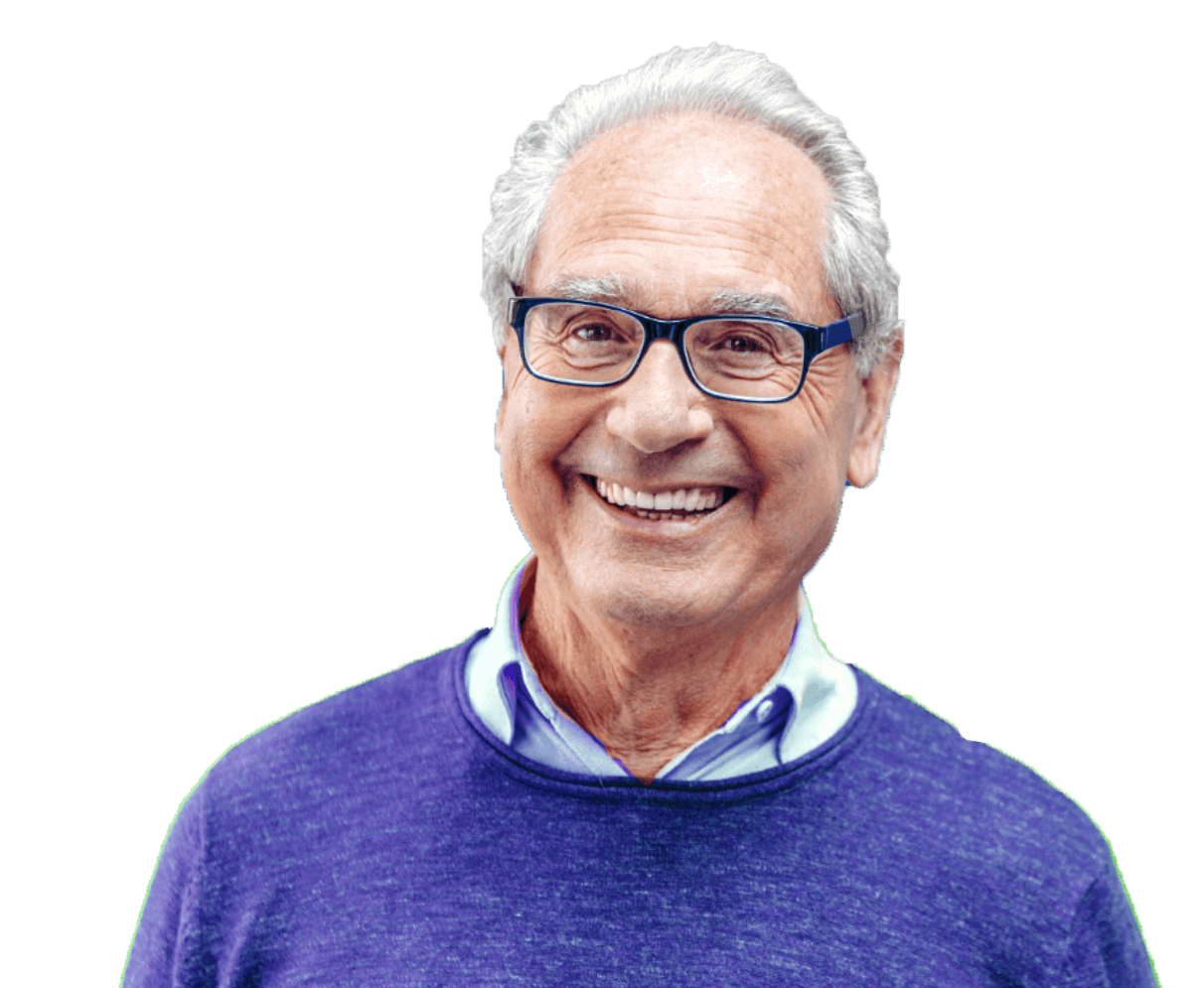
Dr. Edward “Eddie” Loftspring shares how a rising PSA shortly after retirement led to a prostate cancer diagnosis and a difficult journey through conflicting medical opinions before a connection through the Prostate Cancer Foundation helped him find specialized care. After surgery and recurrence detected early through PSMA PET imaging, Eddie became a passionate advocate who now helps other patients navigate treatment decisions, seek second opinions, and find the best possible care.
My name is Eddie Loftspring, Dr. Edward Loftspring. I was a dentist for 40 years. I'm a prostate cancer survivor. Actually, this month is seven years since my surgery. And I got involved with PCF because of the research, and I've used that to help me impact other patients. So my background is I'm not new to the health problems. When I was young, I had Crohn's disease and resulted in an ostomy when I was 21. I was told to give up my dreams about dental school. And when I heard that, I just banged through the doors and did it. And I was very blessed and practiced for 40 years helping patients. And when I was ready to retire in 2017, I was diagnosed with prostate cancer two days after I retired.
So let's back up a little bit. Over the years, my physician, my internist who I've gone to for a long time, has always done PSA tests and everything was fine and no problems as part of the full physical. Excuse me. And just before I retired, I was in for an annual physical. And he said, "Yeah, your PSA's up just from two to four," but it doubled and that concerned him. And because of my other surgeries, he couldn't do a complete exam. So he said, "You need an MRI." And I said, "I'm retiring in two weeks. Can I wait until then?" And he said, "Sure." So I went, got an MRI and they found a big tumor. So that's when my life changed.
And as most men or most anybody that gets cancer, when you hear the word cancer, even though I've had other diseases, it's like getting hit in the stomach by Muhammad Ali in his prime. And the reason I mentioned Muhammad Ali because I've met him several times and admired him. But anyway, but it's that feeling. You feel helpless. And I was. I had no idea where to go, even though I have a medical background, and I got very nervous and anxious. Went to a urologist here in Cincinnati, who will remain nameless. And he said, "You have prostate cancer, but you're almost 70, so you're too old for surgery." He said, "Just do the best you can." And I used a few choice words and told him where he could put it.
And my wife our whole life has been my advocate, and I'm so blessed to be married to Ina for, gosh, 47 years now. So got married a couple years before I was born. But anyway, so we left there and went to another place and got the option of radiation. Well, let me back up. Went to another urologist, and they needed a biopsy, but because of my other surgeries, they couldn't do the rectal biopsy, which fortunately today is becoming obsolete and they get a sub perineal.
But in that time, just seven years ago, wasn't being done in Cincinnati. So we went to Cleveland Clinic where they could do it, and they did the biopsy and found out I had very aggressive prostate cancer now. Now, remember, I never had a symptom at all. So we talked to the people at Cleveland Clinic, and they told me again, I was inoperable, just do radiation. Well, I was coming back to Cincinnati getting ready to do radiation and my life changed. I got a call from a patient of mine by the name of Ed Walderman, and we'd become very close friends.
He said, "I'm very upset. You're retiring. I got to find a new dentist." And I said, "Ed, you're going to be fine. I got a nice young dentist in there. He's going to be great." He said, "I know. I'm just pulling your chain." I said, "Well, I got bigger fish to fry." And I told him, and Ed said, "I can help you." And I said, "Ed, you're a mortgage banker. You couldn't see no blood if you saw it." He said, "I know, but I have a brother-in-law that's pretty well known." Well, Ed's one of 16 children. Turns out his brother-in-law is Joe Torre. He said, "My brother-in-law Joe is involved with Prostate Cancer Foundation. I'll call him."
So Joe called me back and then he called Jonathan Simons, and Jonathan Simons who was the head of the Prostate Cancer Foundation at the time called me personally. And we talked for a short time, not a short time, we talked for quite a while. And he said, "There's only a couple of places you should go." In New York, there's Ash Tewari and Mike Zelefsky and somebody in Boston, I forget who, but we chose New York because of those two. So we flew to New York and didn't know him. And we met Dr. Tewari first, a wonderful person, and he talked to us.
And one thing I want to add, as I go through this, I see a lot of Prostate Cancer Foundation supported doctors, and they all have one thing in common. They treat you like family. They give you all the time you want, and they also have the latest research.
So we met Ash, and we talked to him for quite a while, and he said, "I can do surgery." And my wife said, "Well, why can you do surgery? Nobody else can." He said, "Well, I work with a general surgeon, and because of my other surgeries, I've had a lot of adhesions, which made even the laparoscopic thing more complicated. If he can get me through the adhesions, then I can get your prostate done."
Sounded too simple, but he said, "But you're going to see one of the best radiation oncologists in the country or the world, Mike Zelefsky at Memorial Sloan." And Ash was at Mount Sinai. And I talk a lot too about how the healthcare system's messed up. So here's two different hospital systems working together, and that's the way healthcare should be to get the best care, but we can talk about that at a future time.
So we went to see Dr. Zelefsky, and he examined me. He said, "You've had Crohn's disease and you've had your colon out," and it put a red flag up for radiation. He said, "Would you come back in a couple"... This was, I guess, October, November. "Would you come back in December? I want to do a special test on you."
So we did, and he did a test where he pretended he was giving me radiation, gave me the lead shield and the whole bit, and then he had his nuclear physicist look at the results. And we went back to see him, and he said, "Radiation won't work for you. Where your tumor is, I can't get to it because you don't have much bowel left. And if I hit that bowel." He said, "You need surgery." And I said, "What happens if they can't do surgery?"
He said, "Come back here, and I'll do the best I can." So anyway, so we went and saw Ash and we had the surgery. Took a lot longer because it took the surgeon five hours to get just through the adhesions. They got the tumor out and it was a high Gleason 7, 8 or 8, 9, I don't remember, but they said, "The margins were clear."
And over the years, I would go back up to New York or get a PSA test in Cincinnati at Labcorp because Ash to use Labcorp. And they do an ultrasensive PHA, which I believe in wholeheartedly because it breaks down. You can see much at an earlier level how your PSA increases, especially if you've been diagnosed with cancer. So everything was fine for about a year and a half, then my PSA started going up.
And so this was about 2020, and the PSMA PET scan was not approved, but was just becoming available at that time. So we saw Dr. Zelefsky, and because he was doing the trials, I was able to get the PSMA PET scan, and they picked up my cancer probably a year and a half, two years earlier than they would've found it. They found it in one lymph node. And so they referred me back to Dr. William Oh, who was at Mount Sinai, who's just like Ash and Dr. Zeefsky, is a wonderful person.
And we saw him as an oncologist, and he started me on hormone deprivation and another pill. And I've been off and on that for years, still working with Dr. Oh through Zoom. He's now at Yale, head of research up there, and I've got to know him very well. Came to Cincinnati to lecture, and he's wonderful, just like the other doctors.
Dr. Zelefsky's moved out of Sloan Kettering, but I'm in touch with Dr. Dan Spratt, another PCF supported doctor, and we become friends. He's in Cleveland, and if I need radiation and so he's involved too following my case. And ironically, I went to dental school in Cleveland, so I know the area, know everything about this.
So after I got well, Jonathan invited me, I forget the year now, Shanae, to the Prostate Cancer Foundation Scientific Retreat, and I became hooked there. I sat there with my mouth open to listening to all the researchers. Now I'm a dentist. I had an understanding, not at their level, but I saw something that I've never seen before. As people find out PCF supports over 1,500 researchers all over the world, sound like I'm doing an ad, but I firmly believe it. And because of that, they found treatments for prostate cancer as well as in many, many, many other cancers.
But as they're lecturing, other research would stand up and say, "I've been working on the same thing. Why don't you try this?" It was so collegial and collaborative, and I've learned why the process is so good. These researchers, even though they're separate, work together and to do the best for their patients. And it's really increased the rate of research. So I've been supporting the research.
At this point, people found out about me. I'm involved in Cincinnati called Cincinnati Cancer Advisors where we give free second opinions on patients that have cancer. Not we, but they have a bunch of oncologists. So I become their prostate to-go guy about referrals. And if they can't get treatment here, I use PCF doctors and they're all great. And it's a great thing because like I said, it's free, so money will not stop you from getting the best care.
And I talked to men about early diagnosis and all that kind of stuff. And I enjoy a lot, getting people to the best care. When I was sick, I was thinking I was getting the best care. Why can't everybody get this? And again, I keep coming back to PCF. If you can get to a PCF research supported doctor, you're going to probably get the best care that you can get, and that's how you can start stamping out diseases of prevention, getting the best care, and that kind of thing. So I'm looking forward to still staying involved with PCF. I'm also on other health boards and the FDA panel, and I just enjoy giving back and trying to get people to get the same care I have. And I think if we can do that, we can stamp this out sooner than later.
And I've learned it's not curable. And unfortunately, people are still dying from prostate cancer, but it's much more treatable now. And I'm a recipient of it. I'm on hormone deprivation and an androgen receptor, and I stay on it for about a year and go off and on, and so far so good.
And again, for PCF, their website is fantastic. If you want to learn about diet and exercise, which I've always worked out my whole life, but I've even done it more and honed in on a special diet, eating no meat and eating a lot of vegetables and a healthy diet. Not that that'll be a cure, but I think it helps your body a lot to fight things off. So I'm here if anybody ever wants to contact me and have questions. So that's my long story briefly so...
What have been the side effects from your treatments?
As far as side effects from surgery, fortunately, I've had no urination problems, no leakage, which was lucky. And we talked, and I don't know how close Dr. Torre got to my nerves for erections. We talked. My life was more important for that, so that's been an issue, but it's not an issue, if that makes sense. I'm fine. And so that's all I can think there. I've recovered and work out and swim and lift weights and all. And I used to be a runner and run some marathons. I walk now because of my knees, but they're fine. I just don't want them to go out.
As far as the medication, knock on wood, the only thing I've really had that I can be aware of is a little more tiredness. My blood work's been fine, and hopefully we get that checked. And I think I attribute that to exercise and diet. I know men get hot flashes and all these other things, but I attribute it to the diet and exercise and doing all I can.
What is your current prognosis? Is there an endpoint to your medication therapy?
I think what you need to do is get the right treatment plan, but that starts with the right team, the best radiation oncologist, the best urologist, the best oncologist. At this point, I think this is the treatment for now, but their PCF and research is coming up with new treatments constantly. So I can't say, "I'll ever be cured." I know a lot of cancers, including prostate cancer, there's not a so called cure. I guess sometimes you have surgery and you're cured, but there's treatments and the term is you might not die of your cancer, you'll die with it.
And I don't know the future, but at this point, as long as this keeps working, that's what they'll do. I tease them and say, "I don't know, with the PSMA, the tissue will be a option for me," and who knows what'll be reinvented by that point. But at this point, I stay off of it and they monitor my PSA.
I think last time I did it, I was off two years. And the advantage of being off, if there's any chemical bias side effects, it gives your body a chance to recuperate. But I'm always hopeful that they'll find something else. And like I said, I keep asking Dr. Oh, "Find a cure, Get going."
How can patients best advocate for themselves, as they are going through their treatment journey?
It's an arduous journey, and I've learned that all physicians are not created equally. And so if I had one thing to say, I personally would try to find a research-based physician, if you can, somebody that's on the cutting edge, somebody that's communicative. In this day and age with healthcare, it's 15 minutes with an oncologist and you're out. But I've found with the ones I work with, it's not 15 minutes because we're human. And so I'm sure there's plenty of doctors that I don't know that aren't affiliated with PCF. But again, I know PCF doesn't refer patients, but if you can see who does the research and maybe start there, go to the centers that do it.
I know it's Cleveland Clinic's in Cleveland, but Dan Spratt's at University Hospital in Cleveland. Again, he's research oriented. I know Todd Morgan at the University of Michigan, they have a great program. So if there's somebody that's involved with PCF, you'll probably find that you can get the best care possible. And the main thing is as a guy, when you're diagnosed, don't put it off.
And again, even before that, make sure you get your PSA test. It's better to find out early because you might stamp it out a lot earlier. And I know a lot of men don't go to the doctor. So I guess I would leave it with finding the best doctors you can. And I would start with PCF and seeing he does research. And I don't know, and maybe you'd know, Shanae, if PCF works as somebody that helps with referrals or not. But like I said, I've gotten calls from all over the country because they've heard my name, and I can kind of find out who's in that area and make a couple calls and let them start there.
How do you think talking to someone about your diagnosis impacts your mental health?
I also think that men that are diagnosed with cancer, anybody diagnosed with cancer, anybody that has had a traumatic medical condition, I did 50 some years ago of my ostomy. At that time, you just did it. And I've learned over time, and I did it after I was diagnosed with prostate cancer. Even though I'm in healthcare, and I'm very logical, the cancer word scares you and it puts you in a different frame of mind.
And I think it's invaluable that you talk to somebody because it makes a big difference. I did talk to somebody, and it got me straightened out pretty quickly because you could give your fears and talk to them. And the oncologist, that isn't their role, but it helps your whole treatment because you get in a better state of mind. And I know when I had my surgery 50 years ago, it would've been nice. And I'm involved with the organization and we've put in there, you should talk to somebody with any traumatic situation like that. It's very helpful. And men especially, but anybody could, any kind of cancer or serious condition.
How important is having a support system?
My wife has been there through all my illnesses, believe it or not. So it's imperative that you have somebody with you. I know a lot of people can't, but it doesn't have to be... It can be somebody you know or somebody. You need somebody to advocate for you. I have a medical background, and when I was sitting there early on talking to the doctors, I'm the patient now, so your mind goes blank. And fortunately, I've been very blessed with Ina. I'm extremely blessed, not just because I've been ill. The best person in the world, but she’s very sharp and could ask questions and be my advocate as we go through it.
How vital has PCF been for your prostate cancer journey?
Yeah, I wouldn't be alive today, probably if it wasn't for PCF. And just I was lucky the way I got to Joe Torre, which was... And I love baseball, so that was a double win for me. And if I wouldn't have done that, I don't think I'd be here today. And so I'd say, "Invaluable." I mean, for me, it changed my life, and it changed my life not because I got well, because now I'm involved with it and I enjoy what I'm doing and that kind of thing. And it's fun.
PCF does their big fundraiser every year with Major League Baseball, and I like baseball. So when Mike Milken, if he comes to town, it's kind of a triple wing for me. So when you find the best doctors, you need to get the best treatment plan you can, a full treatment plan. "We're going to do this, and if this doesn't work, we're going to do this."
And again, that's where with PCF, there's radiation oncologists, there's oncologists, there's surgeons, urologists. In this day and age, there's urologists just do the biopsy. They don't do the surgery, laparoscopically and if somebody's going to do laparoscopic, see how many they've done. Everybody has to start somewhere, but see what their training is, but make sure you get a treatment plan that you know, and it's medicine. So treatments can change as your healthcare change, but make sure you have somebody that's aware of where you go if this doesn't work and that type of thing.
Final Thoughts
If you're diagnosed with prostate cancer, it's not hopeless. Find out where you can get the best care. And like I said earlier, talk to people and try to connect with people that do research and that are also caring. But I would say, "Advocate and find the best doctors, ask questions. And if you want another opinion, don't be afraid because if a doctor tells you you don't need another opinion, you know you need another."