

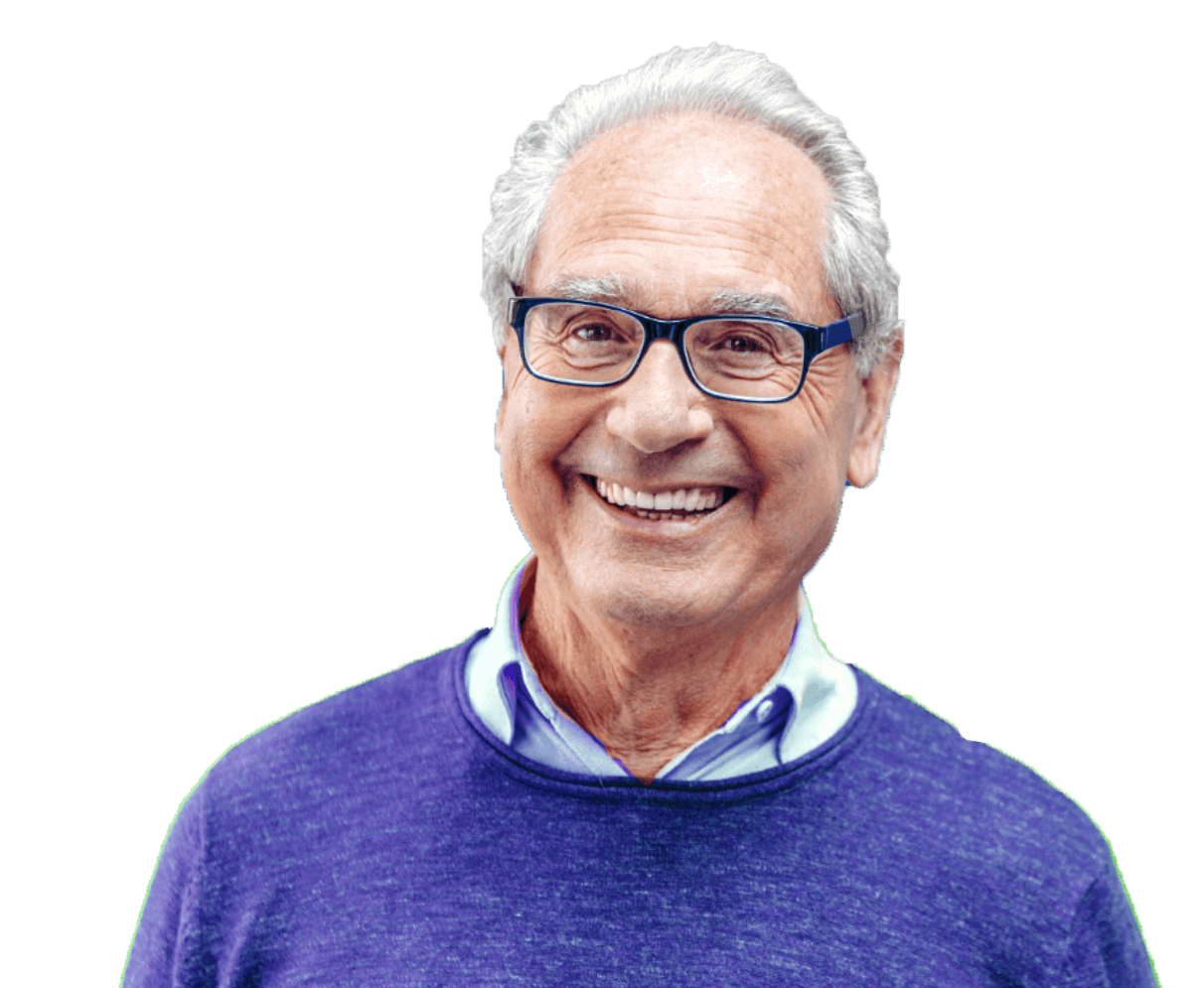
Lenny shares how a routine blood test led to a prostate cancer diagnosis with a high Gleason score and a treatment journey centered on doing whatever it took to be there for his family. Along the way, doctors unexpectedly discovered a separate lung cancer, forcing him to face two cancer diagnoses at once. Despite ongoing treatment and recurrence, Lenny approaches his journey with gratitude, optimism, and a determination to keep living life fully.
My name's Lenny Green. I live in Southern California in the city of Carlsbad, California. I'm a native Californian, but through my career, I've had a chance to live in many states and appreciate learning many cultures, but ultimately, Southern California's home, and I'm so glad to be here and just enjoy my life, my kids, and my grandkids.
My father was diagnosed with prostate cancer at 85, so late-onset prostate cancer, which in itself is not a surprise. And so I understood that that happened through a blood test. And the sensitivities revealed that the blood test caused doctors and urologists to act accordingly. My father, at his age, just chose not to pursue any radical treatment.
But as I look back in retrospect, it should have been an alarm bell for me. I wish it was, but it didn't serve as that. And all I can do now is look forward. I've been treated for hypertension and gout for several years. And I was at North County San Diego. I was seeing a internist for my blood pressure and gout, and I needed finally to get some refills on my prescriptions.
And as I look back, thankfully, she said, "I'm not going to write you another prescription until you come in and we get some blood work to make sure we understand how your medications are affecting your blood counts." So sure enough, took the blood test, and this was before Christmas of 2019. She calls me up, and she says, "I got some alarming results on your PSA. It could be that you have an infection, so I'm going to prescribe you some pretty high-powered antibiotics. Go on your trip for the holidays, and when you get back, we'll take the test again."
I got back, took the test again. The PSA hadn't changed, and I should have said the PSA was about 39. It was high. She did the digital rectal test and said, "This doesn't feel normal." So immediately sent me to or referred me to a local urologist. So the local urologist did his own test and immediately scheduled me for a biopsy.
I went through the biopsy, and as many of my brothers know, it's not the most pleasant experience, but it is a means to gaining more knowledge. So it's one of those necessary things. And the biopsy came back with a Gleason score of nine, and many of the core samples, if I'm saying it right, were involved.
My wife and I went back and met with the urologist, and sadly, it wasn't very encouraging. I mean, he told the news as it is, but I didn't get a lot of sense of a lot of hope. And at that point, I made the decision right then and there that I really wanted to go and further my treatment and further analysis and understanding at a teaching hospital, which for me in Southern California or San Diego County would be UC San Diego. I immediately reached out and made an appointment. Luckily, they were taking new patients and began my relationship with UC San Diego.
Initially, I met with a urologist, surgeon, and he came in and kind of told me what he understood. He then ordered an MRI and I came back and they reaffirmed what they had seen. And I met with a multidisciplinary team, Dr. Rana McKay, A.J. Sandhu, and at the time, Dr. Kelly Parsons, who was the urologist surgeon, each of them kind of sold their specialty, honestly. The surgeon sold the benefit of radical prostatectomy. The radiation oncologist sold the benefit, and Dr. McKay and regular oncology said, "I'm here to pick up the pieces, if you will." But after a while, we sat there and decided that it's probably going to take three good efforts to really knock this down. And Dr. Parsons said, "Look, would you rather go into a fight with just two punches or three?"
And so that was a decision. It didn't take a long time. This was about survival. This was about making a decision to be here for my family above anything else. Nothing else mattered ultimately, but being here to enjoy my life and being here for my family.
So the first treatment protocol was scheduling the surgery, but as that was scheduled, I received a call from Dr. McKay, and she said, "Mr. Green, I was looking at some of your scans, and when they did the pelvic scan, the lower lobes of your lungs were also visible." And I happened to see a spot on your lower left lobe. Now, it could be nothing, but I think at this point we owe it to ourselves to be very, very thorough. So I'm going to kind of put things on hold, and I want you to go get a PET scan."
So I went and got a PET scan, and it came back negative. And I'm cheering, going, "Yay." She says, "That's good news, but I also have some bad news that we need to continue to investigate what this is." From there, I went into an interventional radiology biopsy, which again, among all the procedures I've gone through, is probably the least favorite, but went through the biopsy. I was sedated a little bit, but I went into this room where they were using, I believe, like a live CT to guide them to the spot. And they went through my back and punctured the lung to get that piece of tissue. After they were done, I began coughing up blood. So, they were very concerned that I was going to have a collapsed lung.
They took me back to the pre-op room where I was, and they stationed a nurse with me there for six hours. I literally had to stay in the room, sitting almost like I am now, getting chest X-rays every 30 minutes to make sure my lung was draining and healing. So finally, when they determined that I was no longer at risk of a lung collapse, they let me go home. This whole time, this was early 2020. And as we all know, in early 2020, we were all hunkering down for Covid. So in this scenario, my wife had dropped me off and said, "Give me a call when you're done." She didn't expect it to be six hours later. Nonetheless, she picked me up, and I went home.
Well, the results came back that it was a separate cancer. And so Dr. McKay called me, she said, "I have good news and bad news." She says, "The good news is that what we found in your lung is not related to your prostate cancer. The bad news is it's another form of primary cancer."
So reeling from the diagnosis of that, my family had come down, my kids had come down, my son, daughter-in-law, and daughter from the Bay Area, where we all decided to hunker down here in Carlsbad. They surrounded me. And then I get this phone call saying, "Not only do you have prostate cancer, but you have lung cancer." So the surgery that was scheduled for the prostate was pushed off. They immediately elevated the lung cancer as being the most urgent.
I was scheduled to go see a cardiothoracic surgeon in two weeks after. I met with Dr. Patricia Thistlethwaite at UCSD, and she told me, I said, "Can't you just cut out that? " And she says, "That's just not the standard of care." I went in, family dropped me off again with my duffel bag, went in, and had surgery. I was in the hospital for six days, included in that was having a chest tube and things like that. During my stay there, I actually fainted and had a code blue because they couldn't revive me. So just a lot of different things. I'm thankful to this day that everything worked out, but I was never more grateful for the care that I received and made friends with my nurses and just everything I could possibly do to convey my gratitude and to be the best patient I could be because at the end of the day, it's like, "I want to help you help me. So how can I make you smile and make you want to come to my room," type of thing.
The surgery ended, that was April 20th. On June 25th, they had scheduled my radical prostatectomy. In the meantime, I had started ADT therapy because Dr. McKay said, "We at least have to start the fight, and that was not going to interfere with the lung situation whatsoever." The good news is my PSA began to respond accordingly, which was great news. Had the radical prostatectomy in June of 2020, stayed overnight, typical catheter thing, no issues whatsoever. I don't think I slept any better than having that catheter because I never needed to get up to go to the bathroom, and made it past that. And then it was a question of just healing.
In December of 2020, I began a regimen of 28 days of radiation just to completely cross the Ts and dot the Is. I began to see a oncologist for the lung, and I was on ADT following two years for that. In the meantime, they were following my lung and determined that when they took out the lower lobe, there was no involvement with any lymph nodes, which was great.
So it was just checkups. Every 90 days, I get a CT scan to this day, CT scan and PSA. So two years later, when I finished up my ADT, I'd say maybe another year after that, my PSA began to rise a little bit again, which was sad because it meant that there was cancer cells elsewhere in my body. I had a PSMA scan and they determined there was a small lesion on my spine. Had no symptoms whatsoever. The ADT was working again. My PSA was undetectable.
The decision between Dr. McKay and Dr. Tyler Seibert were, "Let's let the ADT do its job. And if it doesn't do its job, we can always radiate it, but let's let it do its job and spare your body from any additional radiation or what have you." My upper lobe of my lung began to show some nodules that they figured were, from an educated guess, were probably related to the cancer that I had. And they did some testing and determined that I had the EGFR gene, which is very common in non-small cell lung cancer.
So we've been watching that, but about three weeks ago, I began a new medication called Tagrisso for the lung to help suppress and hopefully dissolve those nodules. It's been a little bit of a challenge to get used to the new medication, but if I sit here today, I will tell you I have no complaints at all. I'm living my life. I'm still working. I am still a bundle of gratitude.
Every caregiver I run into, I want to hug and thank just because, yes, it's their job, but they chose a job and a vocation to help people. I just want to let them know that I'm so grateful. And again, what can I do to help you help me? That's where I'm at now. I'm on ADT for a prolonged period for my prostate cancer. Side effects are almost negligible at this point.
I've just started Tagrisso and I'm just hoping and praying that being on both medications while it's known there's no interaction, I'm hoping that being on both medications will allow me to carry on my life and extend my life as long as possible. I plan on retiring in the near future. I'm looking forward to traveling and establishing a new purpose in my life beyond my career to help others and to put smiles on other people's faces.
Well, the good news is that I would say that my providers didn't approach it. I'm sure most providers don't look at you and say the sky's falling. And that certainly wasn't the case here. It's like we have this under control. We know what to do. For the lung cancer, it was never stated this is an aggressive form and so on. I felt a little bit at ease there, and the scans following the diagnosis and the surgery kind of proved that true.
On the same side, on the prostate cancer side, I think I've done a lot to help knock it down. I think we're in a stage now of managing prostate cancer cells that still may exist in my body. So I'm trying to look at it from a glass-half-full standpoint. In my opinion, there's really no other way to do that because there's so much to live for. I have things that I need to do better. I need to exercise more and improve my nutrition. There are things that I can do to help in my personal outcome.
In my view, there's no other way to look at it than a glass-half-full because if not, you just are debilitated by anxiety, and ultimately that's no way to live. If you are diagnosed, number one, I'm sorry, this isn't a club we wanted to join, but we are together and lean on friends or relatives that may have experienced what you're experiencing now, because together we can help each other through this, and also really focus on exercise and nutrition and just keep a positive attitude. The advancements that are taking place even since 2020 have been remarkable, and the chances are that we will pass away with prostate cancer, not from prostate cancer.