

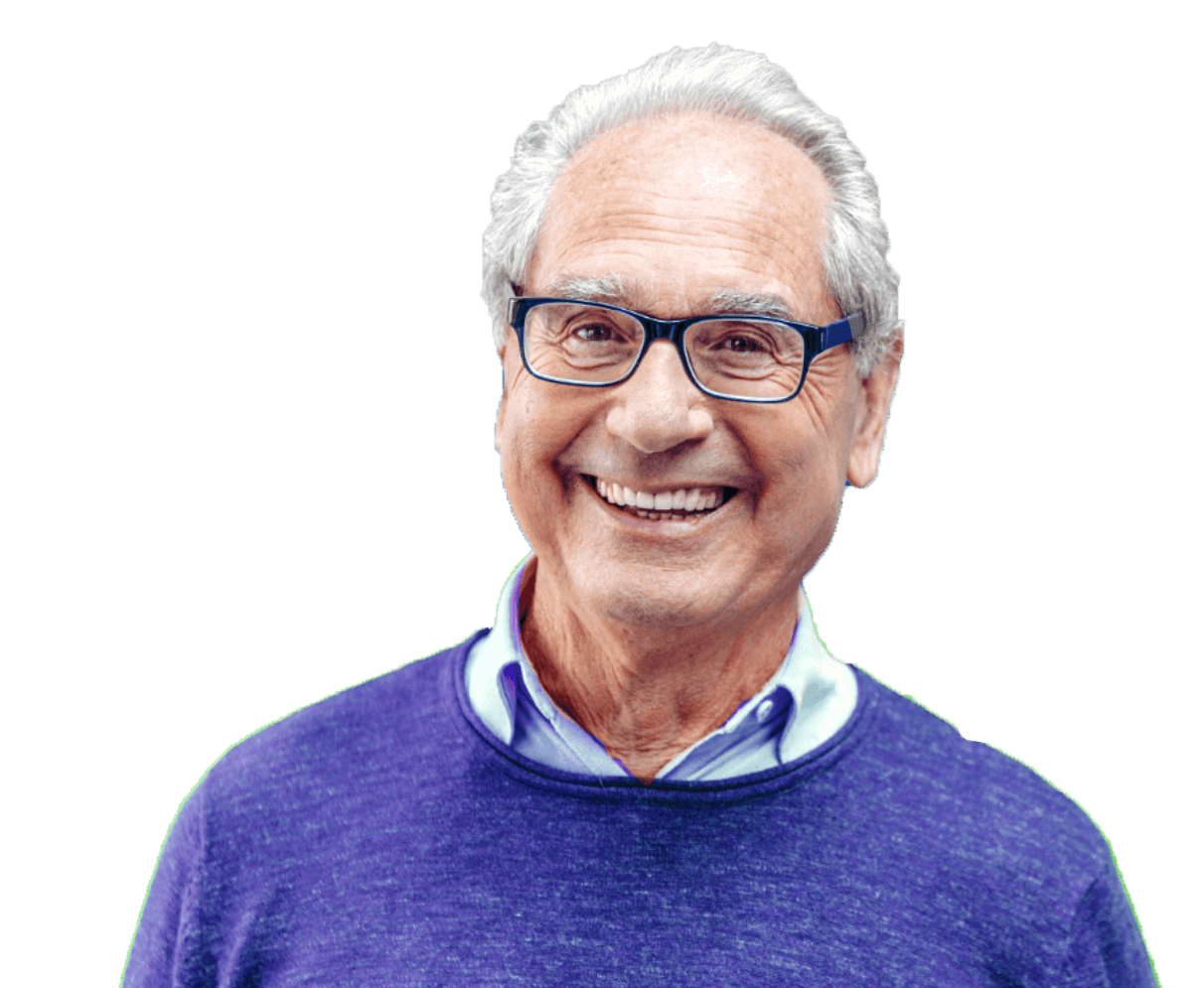
Richard shares how losing his father to advanced prostate cancer shaped his own approach to screening and treatment. He discusses how a conversation with his primary care physician led to a life-saving PSA test, undergoing surgery during the COVID-19 pandemic, and later navigating salvage radiation and hormone therapy after experiencing biochemical recurrence.
My name is Richard Kruse and I'm 68 years old, soon to turn 69. I've lived in San Diego area since 1977, transferring out here to all three universities, San Diego State, then USD, then UCSD.
My home was Chicago and I couldn't be more grateful than to be here in San Diego where UCSD Health is. I grew up in pretty much a single-parent household. My father was an executive with IBM in Chicago. My mother died when I was 14 months old, so never got to know her.
Came out here in 1977. And wouldn't you know, two years later, in 1979, right after I graduated, he waited until after I graduated, he informed us that he had prostate cancer. And it was pretty severe back then. This is 1980, 1979, right in that area. It was a very high stage. It was in his lymphs, in his bones.
I cannot tell you how tough it was living at home with him while he was undergoing treatment and I was completing graduate business school at USD. I remember nights where he would bang on the wall with his fists because he needed morphine. That's how bad it was. So he lived about two years after being diagnosed. He probably had it in the late '70s into July of 1981 when he passed away. So it was a horrible moment for all of us. I was just starting a career and felt like an empty nester.
So I've been aware of prostate cancer my whole life. But I had never really been tested that frequently. Perhaps once a year later in life, in my 50s. And then there was a period around 2015 or so where the medical profession, and this is a layman's term that I'm referring to, but there were false positives. There was a period where PSA testing wasn't done as frequently. I'm someone that probably needed it every year, but it was four and two-third years, almost five years until I was tested. And then we saw the spike. And that was in early 2020.
I work out with a trainer two, three times a week at my gym in La Jolla. And they thought I was having a heart attack because I was down in the gym and while sitting, I would get chest pains. Went to the ER at UCSD Thornton in La Jolla and Dr. Medak looked at me. They ran about every test they could and subsequently ran some tests on my heart and so forth.
I've got to make a mention here of Dr. Suraj Achar, a family and sports medicine doctor. He's been my family and sports medicine doctor since day one. I love the guy. As I was walking out of the office, literally in the doorway, he goes, "Anything else?" And this is where we caught it. I said, "It takes me a while to go number one. I mean, a long time." And he goes, "Okay, bye-bye." And I left. And had that moment not happened, I can guarantee with all certainty I would not be sitting here today. Incredible. And he asked me that question.
So he ordered a PSA test. And lo and behold, my PSA went from nominal levels of under 3.99 and spiked all the way up to 9.17, I think it was. So we knew right then and there, something has happened.
So the next thing was for him to refer me. He referred me to Dr. Karim Kader, who I love and adore. He is the kindest man, the smartest man, one of the best men on earth. He is such a gem. And I went and saw him. He did a DRE test on me and said, "Oh yeah, you've got an enlarged prostate and likely something going on there."
So he did a biopsy in March of 2020. They took the 12 cells and then an additional one and they found out, yes, you've got prostate cancer. It was a Gleason 7, stage, I think they call it 3-plus or maybe it was 4-minus, but it was a Gleason 7. And at that point we decided I need surgery. I was 63 years old.
We got to looking at scheduling surgery for me, which occurred on May 6th of 2020, ironically, my father's birthday. And they came to me and said, "Rick, there are no beds. Our hospital is full of COVID patients. We have no beds. We're only doing the most severe emergency surgeries that there are. If something happened with your heart or something, it stopped, of course. But otherwise, we don't think we can help you. We don't think we have a bed for you."
Dr. Achar, bless his heart, and Dr. Kader, bless his heart, and perhaps with the help of Dr. Kane too, I don't know, but they took my case to hospital leaders given the history with my father. So they did it to hospital leader. Hospital leaders said, "Okay, let's get him in."
On May 6th, 2020, my wife dropped me off the hospital. She couldn't come in, of course. And I remember it well beforehand. There must have been about 13 people in the room there. It was the da Vinci, I think the da Vinci Xi or whatever the ... It was a RARP surgery. Before Dr. Kader put me out, I said, "Dr. Kader, you know what happened to my father. Do as much as you want. Take as much out as you can. I'm fine with it." We don't have kids. I just have my beautiful wife I've been married to since 1984. I didn't want to leave her. So that's what happened. I was in the hospital in Thornton overnight for one night, went home.
She's my rock. She's 180 degrees from me, fortunately. I'm a real type-A, driven person. But she's been so supportive of me during all this time. She's pretty much like ... I'm like this. She's pretty much like that. So she's always been there for me and doesn't overthink things or get too wound up like I do.
What happened since, so under Dr. Kader's care, I saw him every three months. We did a ultrasensitive PSA test. The ultrasensitive is incredible because I was under .01 and we could at least monitor and see how that had changed.
So when it got to 1.0 ... 2.0 is usually the big panic button. 1.0, I went and saw Dr. Kader and we both said, "Yeah, it's time." We looked at each other and literally said, "It's time." Dr. Kader referred me to Dr. Brent Rose, another person I love and adore, and also wanted to have a medical oncologist. So I selected, and everyone agreed, Dr. Rana McKay, who's another one I love and adore.
The BCR, it did come back. This would've been right around the summer of 2024. We were in Taos for the summer and I flew back for a PSMA test, flew back to meet with Dr. Rose and Dr. McKay. And I have to say one thing, and that is Dr. McKay was leaving on a trip to I think it was Africa. It must have been 8:00 at night Pacific Time. We were in Taos, New Mexico, 7:00, and she had the goodwill and the heart to stay on that call, to have that ... We did a video conference because I was away. Dr. Rose, I met in person. Bless her heart. We had a conversation. She didn't rush it. We must have spent 30, 45 minutes, and here she had a plane to catch internationally the next morning. It says a lot about her.
So we came up with a plan, this is 2024, that salvage radiation would be needed. And so we started that in September of 2024, mid-September. And then with Dr. McKay, we started ADT, drug therapy, and I was very fortunate. She didn't even hesitate. It worked out great. I was on that for six months until March of 2025, just last year.
Radiation, I really had trouble. We started this September 2020. I really had trouble with managing kind of the three things in your body. And that is gas, water or urine, and poop. And I had a problem with that. So the first two weeks we did the prostate area. And one time, I had to be sent home. A few other times, I had to walk around the block. I had to drink more water. All these things happened. I got so frustrated.
Dr. Rose came up with the solution to have me go to Ethos, on the Ethos radiation. That was the answer to all answers. And I know it's still five years or so in the future. It's not for everyone because of limited technology. It's still in some beta testing and things, but that was the answer for me. It worked. And a physicist would come out and adjust me every time for 30, 40 minutes. I'd undergo the procedure and go home. It was a godsend that that happened. And that's why I'm even more blessed with UCSD Health and the team I have.
Dr. McKay told me in May of last year, 2025, "Rick, your testosterone's come back pretty much to middle normal. Your USPSA is less than .01," and it's been that way ever since. So we're talking almost a year.
I won the lottery literally with UCSD Health and this family of doctors. I retired at 49 years old. That's what I failed to say. I'm 60. I'll be 69 next week. And the reason I did is I didn't want what happened to my father where he only had literally no time after a 30-year career to enjoy life. And yes, I've enjoyed life perhaps a little too much in the last 20 years.
But I just want to finish and say one other thing, and that is we sponsor four projects at UCSD Health. Three are cancer center related. One of those is actually an Ethos innovation fund. I got so taken by this technology. I come from hardware/software, and I got so taken by it that that's a new project that we started with Dr. Rose, because I asked him, "What can we do? Come up with something." And he did. And then the other project we sponsor is Dr. Achar's Autism Sports Project for Scribes, and they get awards and so forth.
I don't want any self-gratification on this or whatever, but I will say this, and this I want to say to Patty Mason, and that is thank you. And this is just the tip of the iceberg of what we're going to do. We've got some things going on in the works or need to, and I just couldn't be more grateful for UCSD Health, my team of doctors for almost the past 50 years. So thank you and namaste.